
Think in Maximum Utility
An economics concept applied to life

If you are like me, you have at some point sat in a classroom and thought: What is the point of any of this? Not as a passing frustration, but as a genuine, sitting-in-your-chest kind of question. Like something wasn’t adding up. Like the gap between what was being taught and what life actually required was so wide you weren’t sure a bridge existed.
I remember one Accounting class during my undergraduate days. I looked around the room and felt, not boredom exactly, but disconnection. Like I had wandered into the wrong story, it felt like an epiphany of the wrong kind: that I was supposed to be doing something else, somewhere else, and that nothing in that room was going to get me there.
Perhaps I was looking through an ignorant lens. A lens that didn’t yet understand what learning really is, or what it is for.
I still believe, genuinely, that there is a lot wrong with the educational systems of today, particularly across Africa. Too many stale concepts. Too much that has no bearing on real life. Too much that needs to be ejected from the current curriculum. That is something I have dedicated significant energy to addressing through the work I am building.
But this piece is not about what is broken. It is about what works. It is about the moments when something you once dismissed as useless suddenly reveals itself as exactly the tool you needed. And it is about one concept in particular that quietly changed the way I approach every single day.
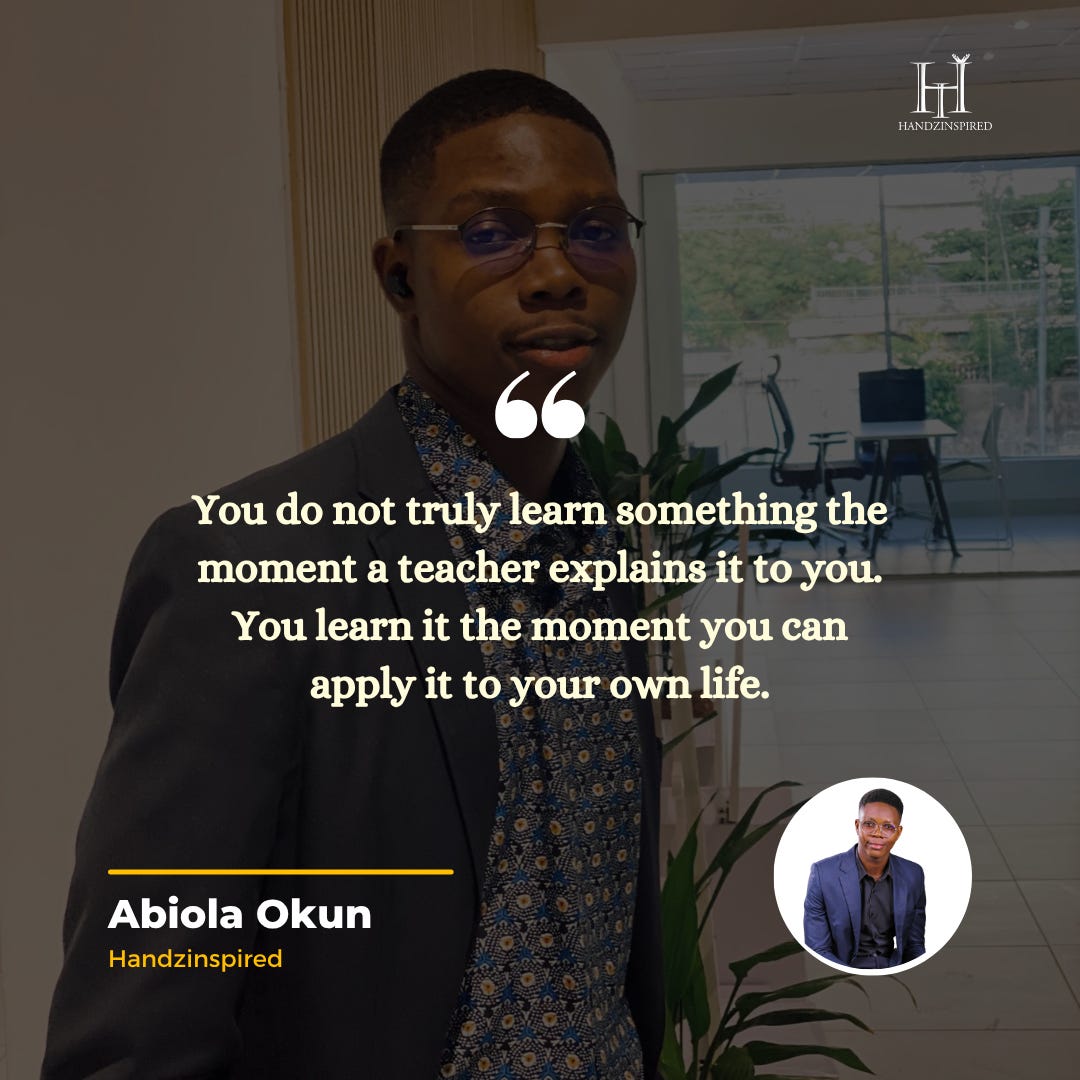
Here is what I have come to believe: you do not truly learn something the moment a teacher explains it to you. You learn it the moment you can apply it to your own life. The moment it stops being information and starts being a lens. That is the AHA, and once it happens, you cannot unhear it.
For me, that click happened with a concept from Economics class.
The first time I ever encountered maximum utility, I was sitting in a lecture, half-engaged, trying to follow along without getting lost in the dy/dx notation I had already decided was not for me. I found Economics genuinely interesting, the ideas, the logic of how the world works. It just became complex when all the graphs started to look alike.
The concept of utility is essentially the satisfaction you get from a product you buy, a service you receive, or even an action that you perform. In terms of economics, it makes total sense, as at the basest level, economics is about scarcity and how it affects the demand and supply of goods and services, from the smallest unit of the economy (an individual) to the largest (trade between countries and continents). It is a great framework for understanding markets. Interesting in a textbook. But on its own, for daily life? It felt like information with nowhere to go.
Until it didn’t.
You do not truly learn something the moment a teacher explains it to you. You learn it the moment you can apply it to your own life.
There was a Saturday, I think a year before graduation, when I was staring at a list of things I could do with my time. I had a few things on the horizon. A social event. A book I had been meaning to read. A business conversation I kept postponing. A rest I genuinely needed.
And I caught myself thinking, which of these gives me the most return? Not financially. But in terms of who I am becoming, what I am building, what I will feel at the end of the day when I look back at how I spent those hours. Which choice delivers the most satisfaction, not just immediate satisfaction, but the kind that compounds?
That was maximum utility. Applied not to a market, but to my life.
I chose the book and the business conversation. I postponed the social event. I did not feel guilty because I had a framework. I was not being antisocial; I was being intentional. I was optimising. And when the day ended, I felt the particular satisfaction that comes from spending time in alignment with your values and your vision. That feeling, I have come to understand, is maximum utility delivered.
What The Maximum Utility Lens Actually Does For You
When you start approaching your days through the lens of maximum utility, something shifts in how you make decisions. You begin to ask different questions. Not just, what should I do today? But, what can I do today that puts me in the best possible position, for my growth, my values, my future? Not just, should I say yes to this? But, what does this cost me, and what does it return?
And here is the distinction that matters most: there is instant utility, and there is delayed utility.
Instant utility is the satisfaction you get right now, the laugh from a scroll, the comfort of avoiding a hard conversation, the ease of rest when you should be building.
Delayed utility (or as it is popularly called, delayed gratification) is the satisfaction that compounds, the growth from a book read, the relationship built through a difficult conversation, the result produced by the work done when you didn’t feel like it.
What can I do today that puts me in the best possible position, for my growth, my values, my future?
The most intentional people I know are masters of delayed utility. They have trained themselves to defer the small, immediate satisfaction for the larger, longer-lasting one. They read instead of scrolling. They build instead of consuming. They invest instead of spending. They choose the harder action today because they can see the utility it will return tomorrow, next year, a decade from now.
This is not about punishing yourself or denying yourself joy. It is about becoming someone who can see further than the moment. Someone who is not ruled by the nearest source of pleasure, but guided by a clear sense of what actually satisfies, deeply, lastingly, meaningfully.
Here’s How You Can Apply This Immediately
Look at your hands. Look at your day. Look at the task in front of you, the resource you are holding, the time you have between now and when you sleep tonight.
Ask yourself: how can this deliver maximum utility to me?
Not what is easiest. Not what feels best in the next ten minutes. But what, if done with intention and clarity, if done in alignment with who you are becoming, gives you the most return on the investment of your time, your energy, and your focus?
The person who thinks this way consistently does not always get everything right. But they end up with more than the person who never asks the question at all. They end up, over time, with a life that reflects what they actually value, because they kept choosing it, one maximised decision at a time.
As it seems, our Economics teacher was teaching us how to live. Perhaps the same applies to other courses.
The important thing is, would you listen, learn, and apply it to life?
To Your Growth,
Your Coach
Abiola Okunsanya
Handzinspired.